
Quantifying Risk: A Data-Driven Look at 3D Printing Air Quality
For me, the conversation around 3D printing usually revolves around speed, calibration, and cost. But recently, the focus shifted to something far more critical: the air I breathe while I create.
Following my open-heart surgery in October, I became acutely aware of the environmental factors in my workspace . I work in a 200-square-foot office, and because I close the door to record, I realized I was essentially printing in a sealed box . This personal realization sparked a deep dive into the invisible byproducts of Fused Deposition Modeling (FDM) .
Beyond Anecdotes: The Data
Section titled “Beyond Anecdotes: The Data”Rather than relying on forum hearsay, I took a rigorous approach. I utilized Notebook LM to synthesize data from 56 different scientific articles regarding emissions . The research highlights two invisible risk factors every maker should understand:
- Ultrafine Particles (UFPs): Microscopic pieces of plastic and debris floating in the air .
- Volatile Organic Compounds (VOCs): Gases released during the melting process, particularly from petroleum-based filaments like ABS and ASA .
Surprisingly, the research indicates that even PLA—often considered the “safe” option—can release VOCs equivalent to ABS depending on the brand, pigments, and additives used . In many cases, PLA is not just plant-based material; it has so many additives that it can cause risks .
Real-World Testing with the K2 Plus
Section titled “Real-World Testing with the K2 Plus”To test the theory against reality, I set up a comprehensive sensor array using the Creality K2 Plus printing ASA . I placed air quality monitors inside the printer’s enclosure, directly outside near a HEPA filter, in the hallway, and downstairs .
The results were telling. The sensors demonstrated that a simple enclosure can act like a fireplace screen, keeping an estimated 95% of particles and gases contained . However, my testing also revealed a critical workflow error. In an attempt to clean the printer glass with alcohol, I inadvertently caused a massive spike in VOC readings, proving that sometimes our cleaning habits can be just as impactful as the printing itself .
Practical Mitigation
Section titled “Practical Mitigation”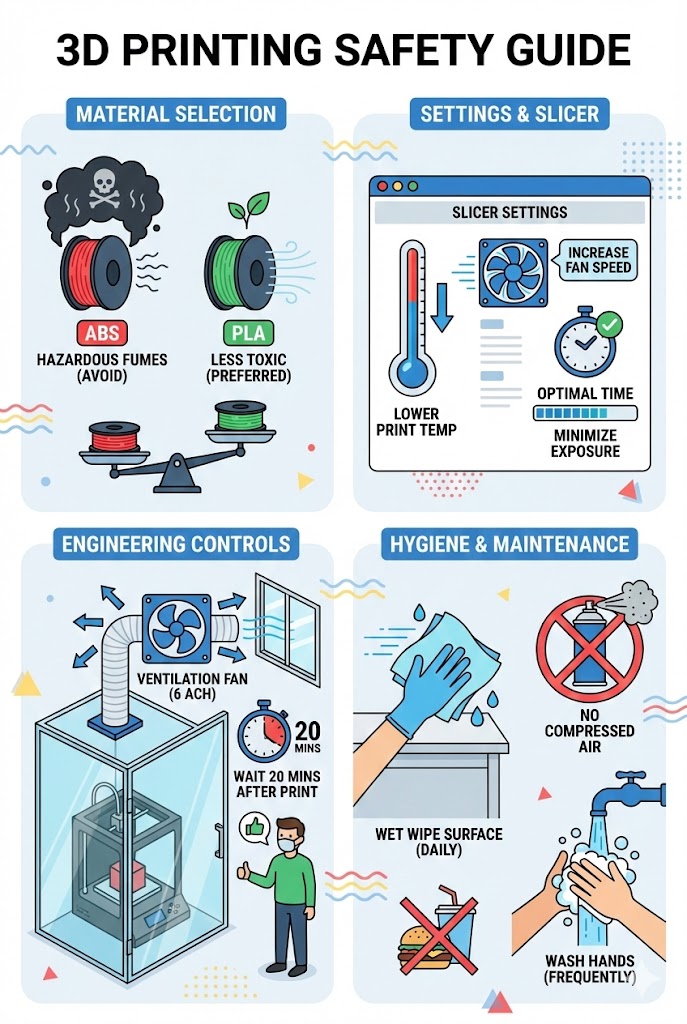
I found several mitigation strategies derived from the scientific research that I now implement:
- Enclosures: This is the first line of defense.
- The “Cool Down” Rule: Letting a print sit for 10 to 20 minutes after completion significantly reduces the release of particles when you open the door.
- Filtration: I recommend getting a HEPA filter that is oversized for your office to exchange the air roughly six times an hour.
For a complete breakdown of the data and to see the sensors in action, check out the full video.
Gear & Resources Mentioned
Section titled “Gear & Resources Mentioned”If you are looking to upgrade your safety setup or replicate these tests, here is the equipment I used in the deep dive:
Air Quality Sensor Used: https://go.minimal3dp.com/go/aq-sensor2
Creality K2 Plus: https://go.minimal3dp.com/go/k2-plus
K2 Plus HEPA/Activated Carbon Filters: https://go.minimal3dp.com/go/k2-plus-hepa
ASA Filament: https://go.minimal3dp.com/go/asa-filament
Support Minimal 3DP:
- Buy Me a Coffee: ko-fi.com/minimal3dp
- Support me on Patreon: Join Here
- Host your projects on Railway: https://railway.com?referralCode=7BPriG
Transparency: We may earn a commission when you make a purchase through our links. Minimal 3DP is a participant in the Amazon Services LLC Associates Program, an affiliate advertising program designed to provide a means for sites to earn advertising fees by advertising and linking to Amazon.com.